CLEC1A
| CLEC1A | |||||||||||||||||
|---|---|---|---|---|---|---|---|---|---|---|---|---|---|---|---|---|---|
| معرفات | |||||||||||||||||
| أسماء بديلة | CLEC1A, CLEC-1, CLEC1, C-type lectin domain family 1 member A | ||||||||||||||||
| معرفات خارجية | الوراثة المندلية البشرية عبر الإنترنت 606782 MGI: MGI:2444151 HomoloGene: 9549 GeneCards: 51267 | ||||||||||||||||
| |||||||||||||||||
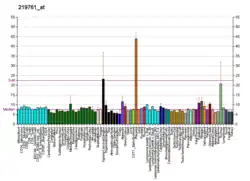
| نمط التعبير عن الحمض النووي الريبوزي | |||||||||||||||||
 | |||||||||||||||||
| المزيد من بيانات التعبير المرجعية | |||||||||||||||||
| تماثلات متسلسلة | |||||||||||||||||
| أنواع | الإنسان | الفأر | |||||||||||||||
| أنتريه | 51267 | 243653 | |||||||||||||||
| Ensembl | ENSG00000150048 | ENSMUSG00000033082 | |||||||||||||||
| يونيبروت | |||||||||||||||||
| RefSeq (رنا مرسال.) | |||||||||||||||||
| RefSeq (بروتين) |
| ||||||||||||||||
| الموقع (UCSC | n/a | Chr 6: 129.4 – 129.43 Mb | |||||||||||||||
| بحث ببمد | |||||||||||||||||
| ويكي بيانات | |||||||||||||||||
| |||||||||||||||||
CLEC1A (C-type lectin domain family 1 member A) هوَ بروتين يُشَفر بواسطة جين CLEC1A في الإنسان.[1][2][3]
يُشفِّر هذا الجين عضوًا من عائلة الليكتين من النوع C/نطاق شبيه الليكتين من النوع C (CTL/CTLD). تشترك أعضاء هذه العائلة في طية بروتينية مشتركة، ولها وظائف متنوعة، مثل التصاق الخلايا، ونقل الإشارات بين الخلايا، ودوران الجليكوبروتين، وأدوار في الالتهاب والاستجابة المناعية. قد يلعب البروتين المُشفَّر دورًا في تنظيم وظيفة الخلايا المتغصنة. وُصِفَت متغيرات الوصل البديل، ولكن لم تُحدَّد طبيعتها البيولوجية بعد. يرتبط هذا الجين ارتباطًا وثيقًا بأعضاء أخرى من عائلة الليكتين من النوع C/CTLD على الكروموسوم 12p13 في منطقة مُركَّب الجينات القاتلة الطبيعية.[4]
المراجع
- ↑ Sobanov Y، Bernreiter A، Derdak S، Mechtcheriakova D، Schweighofer B، Duchler M، Kalthoff F، Hofer E (ديسمبر 2001). "A novel cluster of lectin-like receptor genes expressed in monocytic, dendritic and endothelial cells maps close to the NK receptor genes in the human NK gene complex". Eur J Immunol. ج. 31 ع. 12: 3493–503. DOI:10.1002/1521-4141(200112)31:12<3493::AID-IMMU3493>3.0.CO;2-9. PMID:11745369.
- ↑ Colonna M، Samaridis J، Angman L (مارس 2000). "Molecular characterization of two novel C-type lectin-like receptors, one of which is selectively expressed in human dendritic cells". Eur J Immunol. ج. 30 ع. 2: 697–704. DOI:10.1002/1521-4141(200002)30:2<697::AID-IMMU697>3.0.CO;2-M. PMID:10671229.
- ↑ "Entrez Gene: CLEC1A C-type lectin domain family 1, member A". مؤرشف من الأصل في 2010-12-05.
- ↑ "CLEC1A C-type lectin domain family 1 member A [Homo sapiens (human)] - Gene - NCBI". www.ncbi.nlm.nih.gov. اطلع عليه بتاريخ 2025-04-02.
قراءة متعمقة
- Drickamer K (1999). "C-type lectin-like domains". Curr. Opin. Struct. Biol. ج. 9 ع. 5: 585–90. DOI:10.1016/S0959-440X(99)00009-3. PMID:10508765.
- Strausberg RL، Feingold EA، Grouse LH، وآخرون (2003). "Generation and initial analysis of more than 15,000 full-length human and mouse cDNA sequences". Proc. Natl. Acad. Sci. U.S.A. ج. 99 ع. 26: 16899–903. DOI:10.1073/pnas.242603899. PMC:139241. PMID:12477932.
- Ebner S، Sharon N، Ben-Tal N (2003). "Evolutionary analysis reveals collective properties and specificity in the C-type lectin and lectin-like domain superfamily". Proteins. ج. 53 ع. 1: 44–55. DOI:10.1002/prot.10440. PMID:12945048.
- Clark HF، Gurney AL، Abaya E، وآخرون (2003). "The secreted protein discovery initiative (SPDI), a large-scale effort to identify novel human secreted and transmembrane proteins: a bioinformatics assessment". Genome Res. ج. 13 ع. 10: 2265–70. DOI:10.1101/gr.1293003. PMC:403697. PMID:12975309.
- Ota T، Suzuki Y، Nishikawa T، وآخرون (2004). "Complete sequencing and characterization of 21,243 full-length human cDNAs". Nat. Genet. ج. 36 ع. 1: 40–5. DOI:10.1038/ng1285. PMID:14702039.
- Gerhard DS، Wagner L، Feingold EA، وآخرون (2004). "The status, quality, and expansion of the NIH full-length cDNA project: the Mammalian Gene Collection (MGC)". Genome Res. ج. 14 ع. 10B: 2121–7. DOI:10.1101/gr.2596504. PMC:528928. PMID:15489334.
- Otsuki T، Ota T، Nishikawa T، وآخرون (2007). "Signal sequence and keyword trap in silico for selection of full-length human cDNAs encoding secretion or membrane proteins from oligo-capped cDNA libraries". DNA Res. ج. 12 ع. 2: 117–26. DOI:10.1093/dnares/12.2.117. PMID:16303743.