PAX1
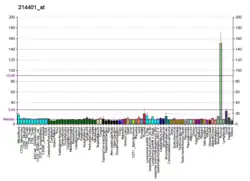
PAX1 (Paired box 1) هوَ بروتين يُشَفر بواسطة جين PAX1 في الإنسان.[1][2]
الوظيفة
هذا الجين عضو في عائلة عوامل النسخ "الصندوق المزدوج" (PAX)، وهي ضرورية أثناء نمو الجنين. وهو ضروري لنمو العمود الفقري البطني. يقتصر تعبيره على الجيوب البلعومية والخلايا المحيطة بالفقرات النامية بالقرب من الجزء العلوي حيث سيتأسس الرأس للمساعدة في تكوين الرقبة وبداية تكوين الكتفين وبراعم الذراعين. تُضيف أنواع السرطان، مثل سرطان المبيض وعنق الرحم، مجموعة ميثيل (CH3) التي تُسكت أو تُعطل الجين الذي قد يكون قادرًا على قمع الورم من خلال تنظيم انقسام الخلايا الأخرى وتكاثرها. يمكن أن يؤدي استبدال أو حذف هذا الجين لدى الفئران إلى إنتاج متغيرات من الطفرة المتموجة التي تتميز بتشوهات في التجزئة على طول العمود الفقري الداخلي. قد تساهم الطفرات في الجين البشري في حالة متلازمة كليبل فيل، وهي فشل الفقرات في التجزئة بالقرب من الجزء العلوي من العمود الفقري وربما إلى أسفل مع أعراض تشمل رقبة قصيرة غير متحركة وخط شعر منخفض في مؤخرة الرأس.[3][4][5][6]
التفاعل
المراجع
- ↑ "Entrez Gene: PAX1 paired box gene 1". مؤرشف من الأصل في 2010-12-05.
- ↑ Schnittger S، Rao VV، Deutsch U، Gruss P، Balling R، Hansmann I (ديسمبر 1992). "Pax1, a member of the paired box-containing class of developmental control genes, is mapped to human chromosome 20p11.2 by in situ hybridization (ISH and FISH)". Genomics. ج. 14 ع. 3: 740–4. DOI:10.1016/S0888-7543(05)80177-6. PMID:1358810.
- ↑ "Genes and Mapped Phenotypes". مؤرشف من الأصل في 2025-03-25.
- ↑ Hofmann C، Drossopoulou G، McMahon A، Balling R، Tickle C (1998). "Inhibitory action of BMPs on Pax1 expression and on shoulder girdle formation during limb development". Dev. Dyn. ج. 213 ع. 2: 199–206. DOI:10.1002/(SICI)1097-0177(199810)213:2<199::AID-AJA5>3.0.CO;2-B. PMID:9786420. S2CID:12943200.
- ↑ Wallin J، Wilting J، Koseki H، Fritsch R، Christ B، Balling R (1994). "The role of Pax-1 in axial skeleton development". Development. ج. 120 ع. 5: 1109–21. DOI:10.1242/dev.120.5.1109. PMID:8026324.
- ↑ McGaughran JM، Oates A، Donnai D، Read AP، Tassabehji M (2003). "Mutations in PAX1 may be associated with Klippel-Feil syndrome". Eur. J. Hum. Genet. ج. 11 ع. 6: 468–74. DOI:10.1038/sj.ejhg.5200987. PMID:12774041.
- ↑ Stamataki D، Kastrinaki M، Mankoo BS، Pachnis V، Karagogeos D (2001). "Homeodomain proteins Mox1 and Mox2 associate with Pax1 and Pax3 transcription factors". FEBS Lett. ج. 499 ع. 3: 274–8. Bibcode:2001FEBSL.499..274S. DOI:10.1016/S0014-5793(01)02556-X. PMID:11423130. S2CID:40668112.
قراءة متعمقة
- Bannykh SI، Emery SC، Gerber JK، وآخرون (2004). "Aberrant Pax1 and Pax9 expression in Jarcho-Levin syndrome: report of two Caucasian siblings and literature review". Am. J. Med. Genet. A. ج. 120 ع. 2: 241–6. DOI:10.1002/ajmg.a.20192. PMID:12833407.
- Burri M، Tromvoukis Y، Bopp D، وآخرون (1989). "Conservation of the paired domain in metazoans and its structure in three isolated human genes". EMBO J. ج. 8 ع. 4: 1183–90. PMC:400932. PMID:2501086.
- Smith CA، Tuan RS (1994). "Human PAX gene expression and development of the vertebral column". Clin. Orthop. Relat. Res. ع. 302: 241–50. PMID:7909508.
- Stapleton P، Weith A، Urbánek P، وآخرون (1995). "Chromosomal localization of seven PAX genes and cloning of a novel family member, PAX-9". Nat. Genet. ج. 3 ع. 4: 292–8. DOI:10.1038/ng0493-292. PMID:7981748.
- Hol FA، Geurds MP، Chatkupt S، وآخرون (1996). "PAX genes and human neural tube defects: an amino acid substitution in PAX1 in a patient with spina bifida". J. Med. Genet. ج. 33 ع. 8: 655–60. DOI:10.1136/jmg.33.8.655. PMC:1050699. PMID:8863157.
- Wilm B، Dahl E، Peters H، وآخرون (1998). "Targeted disruption of Pax1 defines its null phenotype and proves haploinsufficiency". Proc. Natl. Acad. Sci. U.S.A. ج. 95 ع. 15: 8692–7. DOI:10.1073/pnas.95.15.8692. PMC:21138. PMID:9671740.
- Stamataki D، Kastrinaki M، Mankoo BS، وآخرون (2001). "Homeodomain proteins Mox1 and Mox2 associate with Pax1 and Pax3 transcription factors". FEBS Lett. ج. 499 ع. 3: 274–8. DOI:10.1016/S0014-5793(01)02556-X. PMID:11423130.
- Deloukas P، Matthews LH، Ashurst J، وآخرون (2002). "The DNA sequence and comparative analysis of human chromosome 20". Nature. ج. 414 ع. 6866: 865–71. DOI:10.1038/414865a. PMID:11780052.
- Strausberg RL، Feingold EA، Grouse LH، وآخرون (2003). "Generation and initial analysis of more than 15,000 full-length human and mouse cDNA sequences". Proc. Natl. Acad. Sci. U.S.A. ج. 99 ع. 26: 16899–903. DOI:10.1073/pnas.242603899. PMC:139241. PMID:12477932.
- Eraly SA، Hamilton BA، Nigam SK (2003). "Organic anion and cation transporters occur in pairs of similar and similarly expressed genes". Biochem. Biophys. Res. Commun. ج. 300 ع. 2: 333–42. DOI:10.1016/S0006-291X(02)02853-X. PMID:12504088.
- McGaughran JM، Oates A، Donnai D، وآخرون (2004). "Mutations in PAX1 may be associated with Klippel-Feil syndrome". Eur. J. Hum. Genet. ج. 11 ع. 6: 468–74. DOI:10.1038/sj.ejhg.5200987. PMID:12774041.
- Gerhard DS، Wagner L، Feingold EA، وآخرون (2004). "The Status, Quality, and Expansion of the NIH Full-Length cDNA Project: The Mammalian Gene Collection (MGC)". Genome Res. ج. 14 ع. 10B: 2121–7. DOI:10.1101/gr.2596504. PMC:528928. PMID:15489334.
- Giampietro PF، Raggio CL، Reynolds CE، وآخرون (2005). "An analysis of PAX1 in the development of vertebral malformations". Clin. Genet. ج. 68 ع. 5: 448–53. DOI:10.1111/j.1399-0004.2005.00520.x. PMID:16207213.