مجسم جونسون
مجسم جونسون (بالإنجليزية: Johnson solid)، ويُسمَّى أحيانًا مجسم جونسون وزالجلر (بالإنجليزية: Johnson–Zalgaller solid)،[1] هو متعدد وجوه مُحدَّب وجوهه مضلعات منتظمة، وقد تستثني بعض التعاريف متعدد الوجوه المتسقة. يوجد 92 مجسمًا تستوفي هذه التعاريف، وهي تشمل أهرامًا وقببًا وطوارِم، ومتعددات أخرى مركَّبة قد تُنشأ بلصق المتعددات السابقة بعضها مع بعض.
التعريف والخلفية
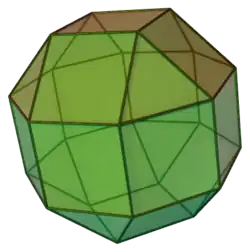
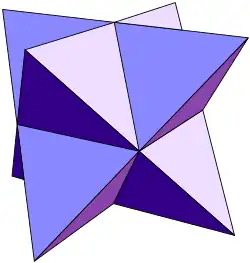
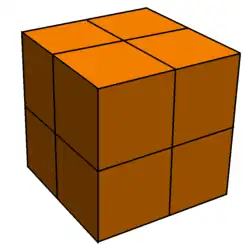
مجسم جونسون هو متعدد وجوه محدب، وجوهه كلها مضلعات منتظمة. [2]. يعني التحدُّب أن مجموعة النقط داخل متعدد الوجوه منغلقة انغلاقًا محدبًا، أي يمكن رسم خط مستقيم من أي نقطة منها إلى أي نقطة أخرى من غير أي يقطع هذا الخط أيًا من وجوه المُتعدِّد.[3] مع أنه لا يوجد قيود على خواص المضلعات المنتظمة التي تُشكل وجوه المُتعدِّد، إلا أن بعض الرياضياتيين يشترطون ألا يكون المضلع متسقًا، وهذا يعني أن كلًا مما يأتي لا يُصنف على أنه من مجسمات جونسون: المجسمات الأرخميدية، والمجسمات الأفلاطونية، والمواشير ومضادات الموشورنص غير متسق.[4][5]
A convex polyhedron in which all faces are nearly regular, but some are not precisely regular, is known as a near-miss Johnson solid.[6]
The solids were named after the mathematicians Norman Johnson and Victor Zalgaller.[7] Johnson (1966) published a list including ninety-two solids—excluding the five Platonic solids, the thirteen Archimedean solids, the infinitely many uniform prisms, and the infinitely many uniform antiprisms—and gave them their names and numbers. He did not prove that there were only ninety-two, but he did conjecture that there were no others.[8] Zalgaller (1969) proved that Johnson's list was complete.[9]
المراجع
- ↑ Araki, Yoshiaki; Horiyama, Takashi; Uehara, Ryuhei (2015). "Common Unfolding of Regular Tetrahedron and Johnson-Zalgaller Solid". In Rahman, M. Sohel; Tomita, Etsuji (eds.). WALCOM: Algorithms and Computation. Lecture Notes in Computer Science (بالإنجليزية). Cham: Springer International Publishing. Vol. 8973. pp. 294–305. DOI:10.1007/978-3-319-15612-5_26. ISBN:978-3-319-15612-5.
- ↑ اكتب عنوان المرجع بين علامتي الفتح
<ref>والإغلاق</ref>للمرجعdiudea - ↑ اكتب عنوان المرجع بين علامتي الفتح
<ref>والإغلاق</ref>للمرجعbk - ↑ اكتب عنوان المرجع بين علامتي الفتح
<ref>والإغلاق</ref>للمرجعtodesco - ↑ اكتب عنوان المرجع بين علامتي الفتح
<ref>والإغلاق</ref>للمرجعwilliams - ↑ اكتب عنوان المرجع بين علامتي الفتح
<ref>والإغلاق</ref>للمرجعkaplan-hart - ↑ اكتب عنوان المرجع بين علامتي الفتح
<ref>والإغلاق</ref>للمرجعuehara - ↑ اكتب عنوان المرجع بين علامتي الفتح
<ref>والإغلاق</ref>للمرجعjohnson - ↑ اكتب عنوان المرجع بين علامتي الفتح
<ref>والإغلاق</ref>للمرجعzalgaller
